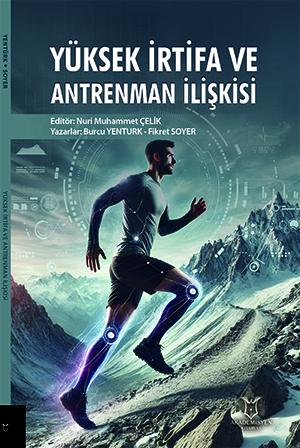
Yüksek İrtifa ve Antrenman İlişkisi
Synopsis
-
References
Abdemalki, A., Fimbel, S., Mayet-Somay, M, H., Sempore, B., Favier, R. (1996). Aerobic capacity and skeletal muscle properties of normoxic and hypoxic rats in response to training. Pflügers Arc-Eur.J.Physiol. 431, 671-679.
Luehr, J.O. (1986). Mental Taughness Training For Sport, The Stephen Greene Press, New York.
Anshel, M.H. (1990). Sport Psycology, From Teory To Practise, Publishers Scottsdale, Arizona.
Gould, D (1986). Applied Sport Psycology, Meyfield Publishing Company, California.
Açıkada, C. (2020). Antrenman bilimi. Spor Yayınevi ve Kitabevi
Akalan C (2014). Antrenman Bilimlerinde Yeni YaklaĢımlar. Ankara Üniversitesi Spor Bilimleri Fakültesi. Doktora Ders Notları.
Gürer, B. (2005). Süphan Dağı Tırmanışına İrtifanın Kaygı Düzeyi Üzerine Etkisi. Gaziantep Üniversitesi, Sağlık Bilimleri Enstitüsü, Yüksek Lisans Tezi,.
Alıncak, F., Ferdi ve Takım Sporlarıyla Uğraşan Bireylerin Strese Karşı Koyabilme Düzeylerinin Karşılaştırması, Yüksek lisans tezi, Gaziantep Üniversitesi Sağlık Bilimleri Enstitüsü, 2012.
Ashenden, M.J., Gore, C.J., Dobson, G.P. vd. (1999). ‘Live High, Train Low’ Does Not Change the Total Haemoglobin Mass of Male Endurance Athletes Sleeping at a Simulated Altitude of 3000 m for 23 Nights, European Journal of Applied Physiology, 80/5, pp: 479-84.
Astrand PO, Rodahl K. Textbook of Work Physiology: Physiological Bases ofExercise. Singapore, Mc.Grav-Hill Book Co.3rd ed. 1986: 683-705.
Bal, F., & Aras, H. (2020). Sporun depresyon üzerindeki etkisinin incelenmesi. Journal of International Social Research, 13(73).
Bartsch , P., Dehnert, C., Friedman-Bette, B., & Tadibi, V. (2008). Intermittent hypoxia at rest for improvement of athletic performance. Scandinavian Journal of Medicine&Science in Sports, 1824-1832.
Bender PR, Groves BM, Mccullough RE (1989). Decreased exercise muscle lactate release after high altitude acclimatization. Journal of Applied Physiology. 67 (4): 1456-1462
Berlund B. (1992). High altitude training: Aspects of haematological adaptation, Spors
Bırd SP, Tarpennıng KM, Marıno FE (2005). Designing resistance training programmes to enhance muscular fitness: a review of the acute programme variables. Sports Med. 35: 841-851.
Bompa TO (1998). Antrenman Kuramı ve Yöntemi, Kültür Ofset, Çev; Keskin İ, Tuner AB, Ankara.
Boyer, S.J., ve F.D.Blume. (1984). Weight loss and changes in body composition at high altitude. J.Appl.Physiol. 57:1580-1585.
Böke T. (1969). Sporda Kondisyon. Cömertiş Tipo Ofset Matbaacılık, İstanbul.
Brooks GA, Fahey TD. (1985). Exercise physiology, Macmillan Publishing Company, New York.
Buskirk ER, Kollias J, Akers RF, Prolop EK, Reategui EP. Maximal performance at altitude and on return from altitude in contiditioned runners. Journal of Applied Physiology.1967, 23-259.
Butterfield GE, Gates J, Fleming S, Brooks GA, Sutton JR, Reeves JT. (1992). İncreased energy intake minimizes weight loss in men at high altitude. J.Appl.Physiol 72(5):1741-1748.
Calbet , J., & Lundby , C. (2009). Air to muscle O2 delivery during exercise at altitude. High Altitude Medicine and Biology, 123-134.
Cerratelli P. Limiting factors to oxygen transport on mount Everest. Journal of Applied Physiology. 1976, 658-667.
Chapman, R. F., Stray-Gundersen, J., Levine, B. D. (1998). Individual Variation in Response to Altitude Training,Journal of Applied Physiology,85/4, pp: 1448–56.
Cinel, Y., Yenigün, Ö., Çolak, T., Özbek, A., & Yenigün, N. (2006). Voleybolcularda maksimal kuvvet gelişimi için uygulanacak antrenman programı seçiminde piramidal yüklenme yöntemi ve tekrar yüklenme yöntemlerinin karşılaştırılması. Ankara Üniversitesi Beden Eğitimi ve Spor Yüksekokulu Spormetre Beden Eğitimi ve Spor Bilimleri Dergisi, 1, 25–29.
Davison GW, George L, Jackson SK, Young IS, Davies B, Bailey DM, et al. (2001). Exercise, free radicals and lipid peroxidation in type 1 diabetes mellitus. Free Radic Biol Med 33(11): 1543–51.
Dever, A., Sosyolojik Boyutlarıyla Spor, Yüksek lisans tezi, Cumhuriyet Üniversitesi Sosyal Bilimler Enstitüsü, Sivas, 2008.
Doğar V. Yüksek irtifada yaşayan elit orta uzun mesafe kosucularm yüksek irtifa ve eniz seviyesindeki fiziksel performansları ile çeşitli kan parametrelerinin karşılaştırılması. Sağlık Bilimleri Enstitüsü. Beden Eğitimi ve Spor Anabilim Dalı. Yüksek Lisans tezi, Ankara: Gazi Üniversitesi, 1995.
Dündar Y, Aslan R. (1999). Bir antioksidan olarak vitamin E. Genel Tıp Dergisi 3(9): 109–16.
Dündar, U. (2015). Antrenman teorisi. Ankara: Nobel Akademik Yayıncılık.
Efek, E., & Eryiğit, H. (2022). Badmintonun Sürekli Kaygı Üzerine Etkisi: Deneysel Bir Çalışma. Mediterranean Journal of Sport Science, 5(2), 269-277. https://doi.org/10.38021/asbid.1113497
Erdem, S. (1992). Seoul Olimpiyat Oyunlarında Fair-Play. TMOK Dergisi, 73.
Erdoğan, P D., Bireysel ve Takım Sporlarıyla Uğraşan Sporcuların Hayal Etme ve Kaygı Düzeylerinin Karşılaştırılması, Yüksek lisans tezi, Sakarya Üniversitesi Sosyal Bilimler Enstitüsü, 2009.
Ergen, E. (1992). Spor Hekimliği Ders Notları, Türk Tabipleri Birliği Merkez Konseyi Spor Hekimliği Kolu Yayını, Ankara. Maya Matbaacılık Yayıncılık Limitet şirketi, 46.
Eroğlu, A. (2011). Aralıklı hipoksik antrenmanın elit sporcuların aerobik ve anaerobik performanslarına etkisi.
Fox EL, Bowers RW, Foss ML. (1999). Beden egitimi ve sporun fizyolojik etkileri. 4. Baskıdan Çeviri ( Yaman H. Çeviri Editörü). Ankara: Bağırgan Yayınevi.
Fox, E., & Bowers, M. (1988). The Physiological Basis of Physical Education and Athletics. New York: Saunders College Publishing.
Frıedmann B, Kınscherf R, Borısch S, Rıchter G, Bartsch P, Bılleter R (2003). Effects of low resistance high repetition strength training in hypoxia on muscle structure and gene expression. Pflügers Arch. 446: 742-751.
Friedman, B., Jost, J., Rating, T., Weller, E., Werle, E., & Eckardt, K. U. (1999). Effects of Iron Supplementation on Total Body Hemoglobin During Endurance Training at Moderate atitude,. İnternational Journal of Sports Medicine, 78-85.
Gerover RF, Reeves JT. Exercise performance of athletes at sea level and 3100 meters altitude. The İnternational Symposium on The Effetcts of Altitude on Performance, The Atletic Institute, Chicago, 1967, 80.
Gilbert DL. (1999). Reactive oxygen species in biological systems. Massachusetts: Kluwer Academic Publishers.
Girak, İ. (2019, 6 15). Futbol Eğitiminde Yüksek İrtifa Maskelerinin Fiziksel Performans Üzerine Etkileri. nin Fiziksel Performans Üzerine Etkileri. Bursa, Türkiye: Bursa Uludağ Üniversitesi.
Girişgin AS, Koçak S, Gül M, Cander B. (2006). Hipotermi ve donmalar, Selçuk Tıp Eğitim Dergisi, 15, 3.
Gore, C. J., Craig, N. P., Hahn, A. G., Rice, A. J., Bourdon, P. C., Lawerence, S. R. vd. (1998). Altitude Training at 2690 m Does Not Increase Total Haemoglobin Mass or Sea Level VO2max in World Champion Track Cyclists, Journal of Sport Science and Medicine in Sport,3, pp: 156-170.
Grosser .M, Starischka S, Zimmermann E (1981). Konditions Training, Müchen
Guyton AC, Hall JE. Çeviri: Çavuşoğlu H. (1996). Tıbbi Fizyoloji, 9. Baskı, İstanbul. Nobel Tıp Kitapevleri Ltd. Şti. 78-79.
Günay M, Cicioğlu İ, Kara E. (2006). Egzersize metabolik ve ısı adaptasyonu. Baran Ofset Baskı Gazi Kitabevi, Ankara. 93–113.
Günay M. (1999). Egzersiz fizyolojisi. Bağırgan. Yayınevi. 2. Baskı. Ankara.
Gürsoy, C. (2021, Nisan 10). CG. Mexcico’da 2240 Metrede Olimpiyat: https:// celalgursoy.com/2016/02/03/mexicoda-2240-metrede-olimpiyat/ adresinden alındı
Hamlin, M., Draper, N., & Hellemns, J. (2013). Current Issues in Sports and Exercise Medicine. New Zeland: İn Tech.
Harre D (1979). Training Slehre Sports Verlag, Berlin. p.;112.
Heinicke,K., Heinicke, I., Schmidt,W., Wolfarth,B. (2005). A Three-Week Traditional Altitude Training Increases Hemoglobin Mass and Red Cell Volume in Elite Biathlon Athletes, International Journal of Sports Medicine, 26/5, pp: 3505.
Helgerud J, Hoydal K, Wang E, Karlsen T, Berg P, Bjerkaas M, Simonsen T, Helgesen C, Hjorth N, Bach R, Hoff J (2007). Aerobic high-ıntens ity ıntervals ımprove vo2max more than moderate training. Med Sci. Sports Exerc. 39 (4):665-71.
Hochachka PW. (1998). Mechanism and evaluation of hypoxia-tolerance in humans. Journal of Experimental Biology, 2001:1243-1254.
Hoppeler H, Vogt M. (2001). Muscle tissue adaptations to hypoxia. J Exp Biol. Sep;204 (Pt 18):3133-9. Review.
Horstman D, Weiskopf R, Jackson R, Severinghaus J. The influence of polycythemina, induced by 4 weeks sojourn at 4300 m, on sea level work capacitiy. Sport Medizin: Höehenphysiologie. 1976, 4-10.
https://celalgursoy.com/2016/02/03/mexicoda-2240-metrede-olimpiyat/)
Hultgren HN, Lopez CE, Lundberg E, Miller H. Physiologic Studies of Pulmonary Edema at High Altitude. Circulation 1964; 29: 393-408.
Ingjer F, Myhre K (1992). Physiological effects of altitude training on elite male cross country skiers. Journal of Sports Sciences. 10 (1): 37-47.
Kalakas SE (1987). Sporcu Sağlığı, Kayseri.
Kalyon TA. Spor Hekimliği, 2. Baskı, Ankara. Gata Basımevi. 1995: 34-35.
Karatosun, H. (2008): Egzersiz ve Spor Fizyolojisi. Altıntuğ Matbaası. Isparta.
Kayser B, Acheson K, Decombaz J, Fern E, Cerretelli P. (1992). Protein absorpsion and energy digestibility at high altitude. J.Appl.Physiol 73(6):24252431.
Kelvin ,J,A., D., Lin,S,W., Pacifici, R, E. (1987). Protein Damage and Degradation by Oxgen Radicals. The Journal of Biological Chemistry. 262(20) 9914-9920
Kırkaya, İ. (2018, 6 15). Aralıklı Hipoksiye Maruz Kalmanın Fizyolojik Ve Performans Değişkenleri Üzerine Kronik Etkileri. Eskişehir, Türkiye: Anadolu Üniversitesi.
Kondo H, Miura M, Itokawa Y. (1991). Oxidative stress in skeletal muscle atrophied by immobilization. Acta Physiol Scand. Aug;142(4):527-8.
Koroglu, M., & Yigiter, K. (2022). Examination of the stress and social phobia levels of 13-18 age group students participating in tennis training: tennis, social phobia, stress. Progress in Nutrition, 24(2), e2022083. https://doi.org/10.23751/pn.v24i2.12287.
Köroğlu, M. & Yiğiter, K. (2016). Effects of Swimming Training on Stress Levels of the Students Aged 11-13. Universal Journal of Educational Research 4(8): 1881-1884. DOI: 10.13189/ujer.2016.040818
Köroğlu, M., & Yiğiter, K. (2020). Bir Fiziksel Aktive Programının 15-18 Yaş Öğrencilerinin Motivasyon Ve Dikkat Düzeylerine Etkileri. International Journal of Social and Humanities Sciences Research (JSHSR), 7(58), 2414-2423.
Köroğlu, M., Abanoz, H. A., Yentürk, B., Öztürk Çelik, G. (2023). Spor Lisesinde Okuyan Öğrencilerin Mutluluk Ve Öz Yeterlilik Düzeylerinin İncelenmesi. Kafkas Üniversitesi Spor Bilimleri Dergisi, 3(3), 70-92.
Kraemer WJ, Ratamess NA (2004). Fundamentals of resistance training: progression and exercise prescription. Med Sci Sports Exerc. 36: 674-688.
Kuter M, Öztürk F (1997). Antrenör ve Sporcu El Kitabı, Bağırgan Yayınevi, Bursa.
Letzelter H, Letzelter M (1986). Krafftraining, Reinbek.
Levine, B. D., & Stray-Gundersen, J. (2006). Dose-response of altitude training: how much altitude is enough?. In Hypoxia and Exercise Springer. Boston: Boston MA.
Lundby C, Calbet Jose A.L, Hall G.V, et al. Pulmonary gas Exchange at maximal exercise in Danish lowlanders during 8 wk of acclimatization to 4,100 m and in high-altitude Aymara natives. Am J Physiol Regul Integr Comp Physiol 2004; 287: 1202-1208.
Magalhaes J, Ascensao A, Soares JM, Neuparth MJ, Ferreira R, Oliveira J, Amado F, Duarte JA. (2004). Acute and severe hypobaric hypoxia-induced muscle oxidative stress in mice: the role of glutathione against oxidative damage. Eur J Appl Physiol. Mar;91(2-3):185-91.
Manımmanakorn A, Manımmanakorn N, Taylor R, Draper N, Bıllaut F, Shearman JP (2013). Effects of resistance training combined with vascular occlusion or hypoxia on neuromuscular function in athletes. Eur J Appl Physiol. 113: 1767-1774.
Martin DE. (1977). The challenge of using altitude to improve perfomance. New Studies in Athletics. Monaco. 51.75.
Mazıcıoğlu M. (2000). Dağlarda beslenme, Spor ve Tıp, yıl:8, sayı:3-4, syf:49-53, Mart-Nisan.
McKenize DC, Goodman LS, Nath C, Davitson B, Matheson GO, Parkhouse WS, Hochacka PW, Allen PS, Stanley C, Ammann W. Cordivascular adaptations in andean natives after 6 wk of exposure to sea level. Journal of Applied Physiology. 1991, 70 (6): 2650-2655.
Mellerowitz H, Meller W, Woveries J, Zerdick T, Ketusinh O, Kral B, Heepe W. Verleichende untersuchungen über wirkungen von Htraining auf die dauerleistung in meereshöhe. Sportarzt und Soptmedizine. 1970, 21-207.
Muratlı S (1997). Antrenman Bilimi Işığı Altında Çocuk ve Spor, “2. Baskı”, Bağırgan Yayınevi, Ankara
Muratlı S, Kalyoncu O, Şahin G (2011). Antrenman ve Müsabaka. 3. Baskı. s.:173-255.
Muza, S. R. (2010). Military applications of hypoxic training for high-altitude operations. Medicine&Science in Sport &Excercise, 87-92.
Noyan A. (1993). Yaşamda ve Hekimlik’de Fizyoloji, 8. Baskı, Ankara. Meteksan Anonim Şirketi, 18-20.
Özcan O. (1992). Yükseklikte Yapılan Antrenmanın Bazı Kan Parametreleri ÜzerineEtkileri. Sağlık Bilimler Enstitüsü. Yüksek İrtifa ve Spor Bilimleri Anabilim Dalı. Yüksek Lisans tezi. Kayseri, Erciyes Üniversitesi.
Peacock Andrew J. (1998). ABC of oxygen, Oxygen at high altitude. BMJ. 317:1063-6
Ponsot, E., Dufour, S. P., Zoll, J., Doutrelau, S., N’Guessan, B., Geny, B., & Richard, R. (2006). Exercise training in normobaric hypoxia in endurance runners. II. Improvement of itochondrial properties in skeletal muscle. Journal of Applied Physicology, 1249-1257.
Pottgiesser, T., Ahlgrim, C., Ruthardt, S., Dickhuth, H. H., Schumacher, Y. O. (2009). Hemoglobin Mass After 21 Days of Conventional Altitude Training at 1816m, Journal of Sport Science and Medicine in Sport, 12/6, pp: 673-5.
Powers SK, Kavazis AN, DeRuisseau KC. (2005). Mechanisms of disuse muscle atrophy: role of oxidative stress. Am J Physiol Regul Integr Comp Physiol. Feb;288(2):R337-44. Review.
Pulfrey,S M., ve Peter J.H.J. (1996). Energy expenditure and requirement while climbing above 6,000m. J.Appl.Physiol. 81(3):1306-1311.
Roels, B., Bentley, D. J., Coste , O., Mercier, J., & Millet , G. P. (2007). Effects of intermittent hypoxic training on cycling performance in well-trained athletes. European Journal of Applied Physicology, 359-368.
Rose,M,S.,C,S, Houston.,C,S, Fulco.,G, Coates.,J,R, Sutton.,Cymerman. (1988). Operation EverstII: nutrition and body composition. J.Appl Physiol.65:2545-2551.
Saltın B. Aerobic and anaerobic work capacity at 2300 meters. Schweiz Z Sportmed. 1966, 14-81.
Saunders, P., Gore, C., Hahn, A., Hawley, J., Telford, R., Pyne, D. vd. (2004). Improved Running Economy in Elite Runners After 20 Days of Simulated Moderate-Altitude Exposure,Journal of Applied Physiology,96/3, pp: 931–7.
Schoenfeld BJ (2013). Potential mechanisms for a role of metabolic stress in hypertrophic adaptations to resistance training. Sports Med. 43: 179-194.
Scott BR, Slattery KM, Sculley DV, Dascombe BJ (2014). Hypoxia and resistance exercise: A comparison of localized and systemic methods. Sports Med. 44: 1037-1054.
Serebrowskaya, T. V. (2002). Intermittent hypoxia research in the former Soviet Union and the Commonwealth of Independent States: history and review of the concept and selected applications. High Altitude Medicine&Biology, 205-221.
Sevim Y (1995). Antrenman Bilgisi, Gazi Büro Kitapevi, Ankara.
Sevim Y (2002). Antrenman Bilgis i. 1. Baskı. s.:60-75.
Suslov FP. Basic pirinciples of training at high altitude. New Studies in Athletics, Monaco.1983, 45-50.
Sutton JR. (1994). Exercise training at high attitude, swiming technique: pp 12-15 february – april.
Şeker, İ., Harran Üniversitesinde Spor Yapan ve Spor Yapmayan Üniversite Öğrencilerinin Sosyal Beceri, Saldırganlık ve Spor Ahlakı Düzeylerinin İncelenmesi, Yüksek lisans tezi, İstanbul Gedik Üniversitesi Sağlık Bilimleri Enstitüsü, 2020.
Taşkıran, Y. (2007). Antrenman bilgisi. İstanbul: Akademi
Tiryaki G. (1991). Yüksek rakımda egzersiz ile ilgili son yaklaşımlar, I.Yüksek İrtifa ve Spor Bilimleri Kongresi, 30 Ekim – 2 Kasım. 71-87.
Topsakal S. (1992). Fen ve Tabiat Bilgisi, Bursa. Uludağ Yayınları, 22-23.
Wagenmarker A.J.M. (1992). Amino Acid Metabolism, Muscular Fatigue and Muscle Wasting, speculation on adaptation at high altitude. Int. J. Sports Med. 13:110-113.
Wagner, P. D., Gale, G. E., Moon, R. E., Torre-Bueno, R., Stolp, B. W., & Saltzman, H. A. (1986). Pulmonary gas exchange in humans exercising at sea level and simulated altitude. Journal of Applied Physiology, 260-270.
Wehrlin, J.P., Marti, B. (2006). Live high-train low associated with Increased Haemoglobin Mass As Preparation for the 2003 World Championships in Two Native European World Class Runners, British Journal of Sports Medicine, 40/2, (Abstract)
West JB. The physiologic basis of high-altitude diseases. Ann Intern Med 2004; 141: 789-800.
Westerterp KR, Meijer EP, Rubbens M, Robach P, Richalet JP. (2000). Operation Everest III: energy and water balance. Pflugers Arch. Feb;439(4):483-8.
Wilber, R. L. (2007). Application of altitude/hypoxic training by elite athletes. Medicine & Science in Sports & Exercise, 39(9), 1613-1624.
Wilmore JH, Costil DL. (2004). Physiology of Sport and Exercise, Human Kinetics, s. 45-53, 39-44, Hong Kong. 3.
Yalçın Y. Spor tatmininin sporcuların stres ve saldırganlık düzeyleri üzerindeki etkisi: antrenör cinsiyetinin rolünü belirlemeye yönelik Antalya ilinde bir uygulama 2009, Erciyes Üniversitesi Sosyal Bilimler Enstitüsü Spor Yöneticiliği Anabilim Dalı. Yüksek Lisans Tezi, 216 sayfa, Kayseri, (Doç. Dr. Mahmut Özdevecioğlu),
Yaman M.ve Coşkuntürk O. (1992). Sportif performansın sınırları. Ankara.
Yıldız, M., Sporcuların Değer Yönelimleri, Doktora tezi, Gazi Üniversitesi Eğitim Bilimleri Enstitüsü, Ankara, 2016.
Yıldız, Ö., Takım Sporlarında İletişimin Performans Verimine Etkisinin Araştırılması, Yüksek lisans tezi, Gazi Üniversitesi Eğitim Bilimleri Enstitüsü, Ankara, 2004.
Published
License
LicenseBu İnternet Sitesi içeriğinde yer alan tüm eserler (yazı, resim, görüntü, fotoğraf, video, müzik vb.) Akademisyen Kitabevine ait olup, 5846 sayılı Fikir ve Sanat Eserleri Kanunu ve 5237 sayılı Türk Ceca Kanunu kapsamında korunmaktadır. Bu hakları ihlal eden kişiler, 5846 sayılı Fikir ve Sanat eserleri Kanunu ve 5237 sayılı Türk Ceza Kanununda yer alan hukuki ve cezai yaptırımlara tabi olurlar. Yayınevi ilgili yasal yollara başvurma hakkına sahiptir.